

Commitment for 70% of Stroke Patients Who Discontinue Their Rehab Treatment Midway"

The journey back from a stroke is not just a medical problem. It is a deeply personal, tiring battle fought inside the quiet walls of a family home.
In India, a stroke turns a family's world upside down in a single second. Statistics show that roughly 2 out of every 10 people will face this crisis.
While doctors in the ICU work fast to save the patient's life, the hardest part begins after they come home. This is the long fight to overcome paralysis and win back the ability to walk, speak, and live independently.
Here is the story of how home neuro rehabilitation (rehab) is changing stroke recovery in India, and how B2L Care is helping families smile again.
The Hard Reality for Indian Families
Doctors talk about a special window of time called neuroplasticity. For the first 3 to 6 months after a stroke, the brain is like wet clay. It is highly ready to rewire itself and learn how to move again. This is the absolute best time to start rehab.
However, a sad truth exists in India. A shocking 70% of stroke survivors stop their treatment halfway.
Why does this happen?
High Costs: Long-term rehab centers charge very high fees that quickly empty the savings of middle-class families.
2. Painful Travel: Moving a paralyzed patient to a clinic every day causes them severe physical pain and completely exhausts the family.
3.Stagnant Progress: Using old, repetitive exercise methods often stops showing results. Families lose hope and think the patient will never get better.
Why the Home is the Best Hospital:
True recovery shouldn't happen in a cold clinic. It needs to happen where real life takes place. Modifying rehab to fit an Indian home makes perfect sense for three reasons:
Real-World Practice: Learning to walk on a smooth clinic floor is easy. But home rehab teaches a patient how to step over door sills, walk around rugs, and use their own bathroom safely.
Family Comfort: Being around grandchildren, eating home-cooked food, and sleeping in one's own bed lowers stress. A happy mind heals much faster.
Saving Money: By cutting out travel costs and high clinic fees, families can afford to continue the treatment for a long time.
How B2L Care is Transforming Recovery
B2L Care decided to help the 70% of patients who were being left behind. They brought advanced hospital treatments directly into the patient's living room.
Here is how they are changing lives:
1. A Whole Team at Your Bedside
Healing from a stroke takes a team. B2L Care brings three important experts to your home:
Physiotherapists to rebuild leg and arm strength.
Occupational Therapists to help the patient relearn daily habits, like holding a spoon or buttoning a shirt.
Cognitive Therapists to gently fix speech and memory.
2. Advanced Technology at Home
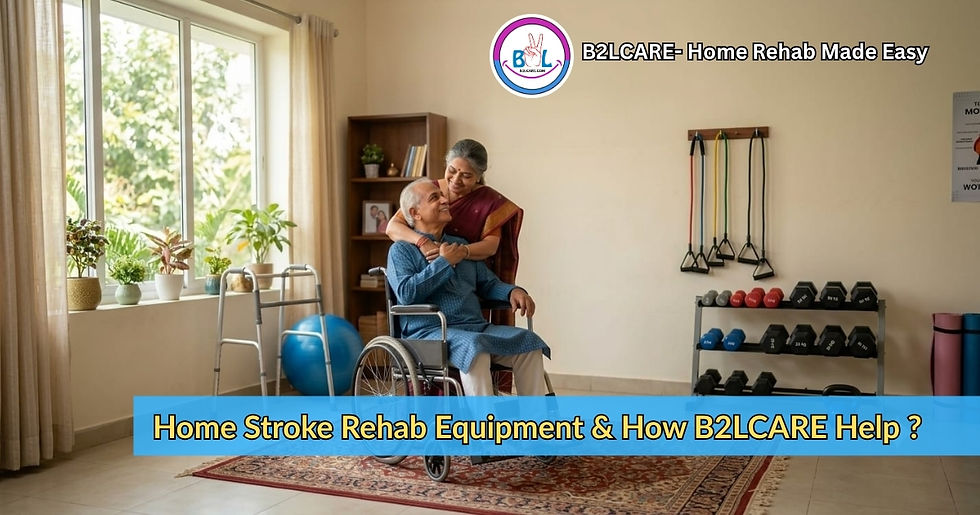
B2L Care proves that you don't need to stay in a hospital to get the best care. They bring portable, modern equipment to your house, including:
EMG Biofeedback: A tool that helps patients see their muscle activity on a screen so they can try to wake up dormant nerves.
Robotic Hand Rehab: Special robotic gloves that help paralyzed fingers practice moving and gripping again.
Fun Game Therapy: Using creative games and basic tools to make hard exercises feel like a fun game instead of boring work.
Proof of Progress: Instead of doing the same exercises every day, B2L Care tracks small daily improvements. They adjust the plan as the brain heals, showing the family clear proof that their loved one is getting better.
4. Relief for the Family
Caring for a stroke patient causes immense physical and mental burnout. By managing everything at home, B2L Care lifts the heavy burden off the family. Children and spouses can stop worrying about medical logistics and just focus on loving their family member.
A New Tomorrow
Because of personalized home neuro rehab, the story of stroke survivors in India is changing. It no longer has to end in defeat because of an empty bank account or travel pain.
With B2L Care, recovery becomes a journey of small, affordable steps taken right at home—guiding patients out of paralysis and back to a life of dignity, free movement, and independence


Comments